Five-Limb Core: When Three Limbs Are Not Enough — and What Replaces Them
Five-limb adds two unwound outer limbs → dedicated zero-sequence flux return path. Enables Yy vector groups, reduces shipping height, handles unbalanced loads. Trade-off: ~15–25% more steel, wider footprint, more complex manufacturing. When to specify — and what to watch.
Introduction: The Problem That Three Limbs Cannot Solve
In the previous article in this series, we explained why the three-limb core is the default for most three-phase transformers — and why it almost always pairs with a delta-connected winding (Dyn11 is the global standard).
But what happens when you need a Yy vector group? Or when your transformer will routinely carry a significant unbalanced load — say, a mix of single-phase and three-phase loads? Or when your shipping route passes through a tunnel or under a bridge that limits your overall height?
Three limbs cannot solve these problems. You need something different.
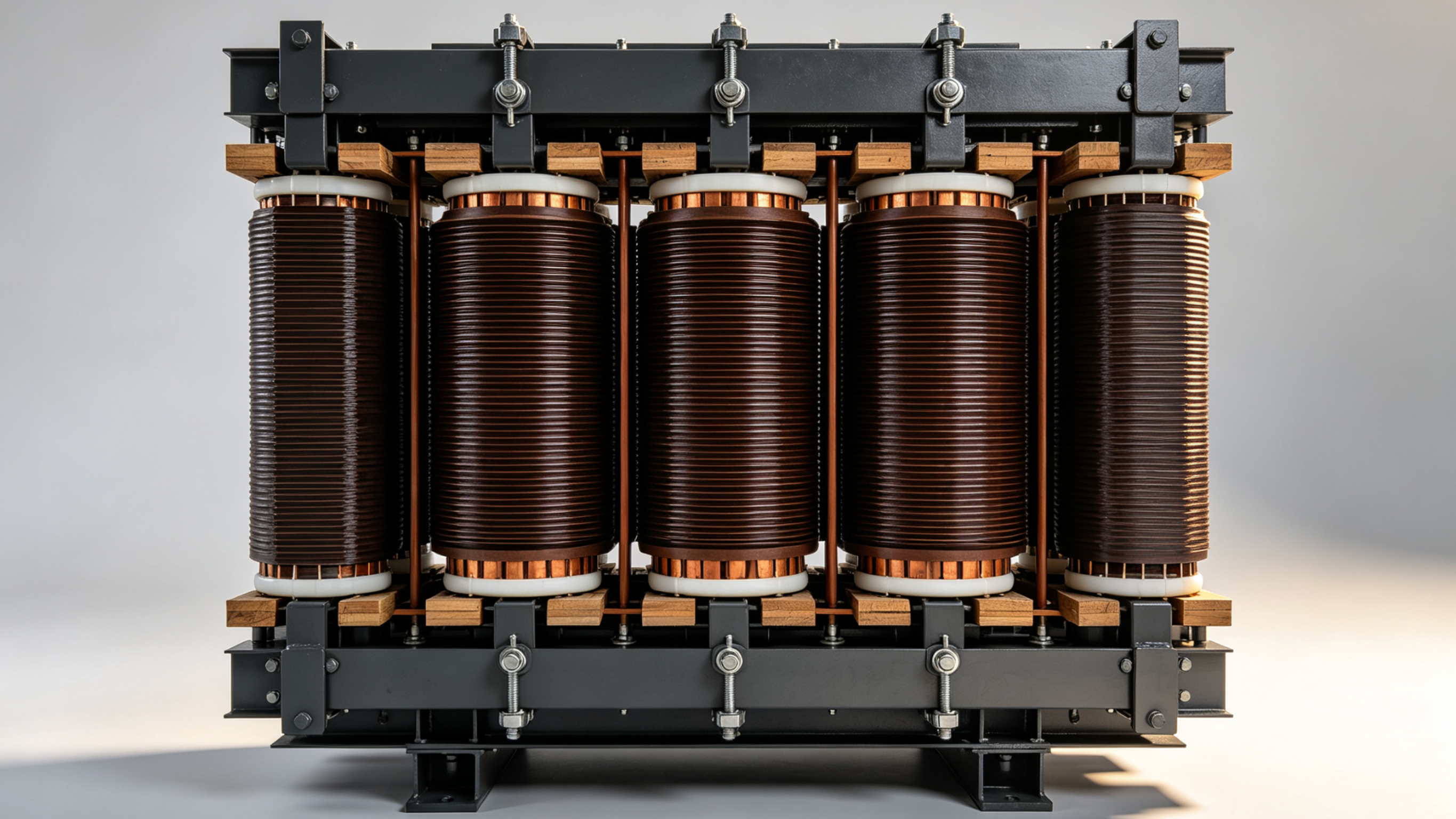
The engineering answer is the five-limb core — two additional unwound outer limbs that provide a dedicated low-reluctance path for zero-sequence flux. It looks like three limbs with two extra sides added, and it changes the electrical and logistics character of the transformer completely.
This article explains the five-limb design from the ground up: why it exists, how it works, where it is used, and what to specify when you order one.
- The Physics: Why Zero-Sequence Flux Needs Its Own Road In a three-limb core, zero-sequence flux has no internal return path. During a ground fault or unbalanced load, the zero-sequence component in each limb cannot circulate back through the other two limbs — they are 120° apart at fundamental frequency, so their zero-sequence components add, not cancel. The flux has to find its way out through the air gap between the tank and the core, through the tank walls themselves, or through any grounded magnetic structure nearby.
This is why a three-limb core with Y-connected windings can overheat the tank during ground faults: the zero-sequence flux is forced through the tank steel, causing circulating currents, local heating, and noise.
The five-limb design solves this by giving zero-sequence flux a dedicated, low-reluctance internal path: the two outer limbs, together with the top and bottom yokes, form a closed loop that the zero-sequence flux can circulate through without ever leaving the core. The tank stays cool and quiet.
Mathematically, the zero-sequence magnetizing impedance of a five-limb core is roughly 5–10× higher than a comparable three-limb core — meaning the transformer is far more tolerant of unbalanced conditions and ground faults.
- Structural Design: What Makes a Five-Limb Different A five-limb core has five vertical columns:
1)Three main (central) limbs — wound with LV and HV windings, exactly like a three-limb core 2)Two outer (side) limbs — unwound, with cross-sectional area typically 50–70% of the main limbs The top and bottom yokes connect all five limbs. The magnetic circuit is fully symmetrical for positive-sequence flux (as in a three-limb design), but now also has a dedicated zero-sequence loop through the two outer limbs.
Key structural differences from three-limb:
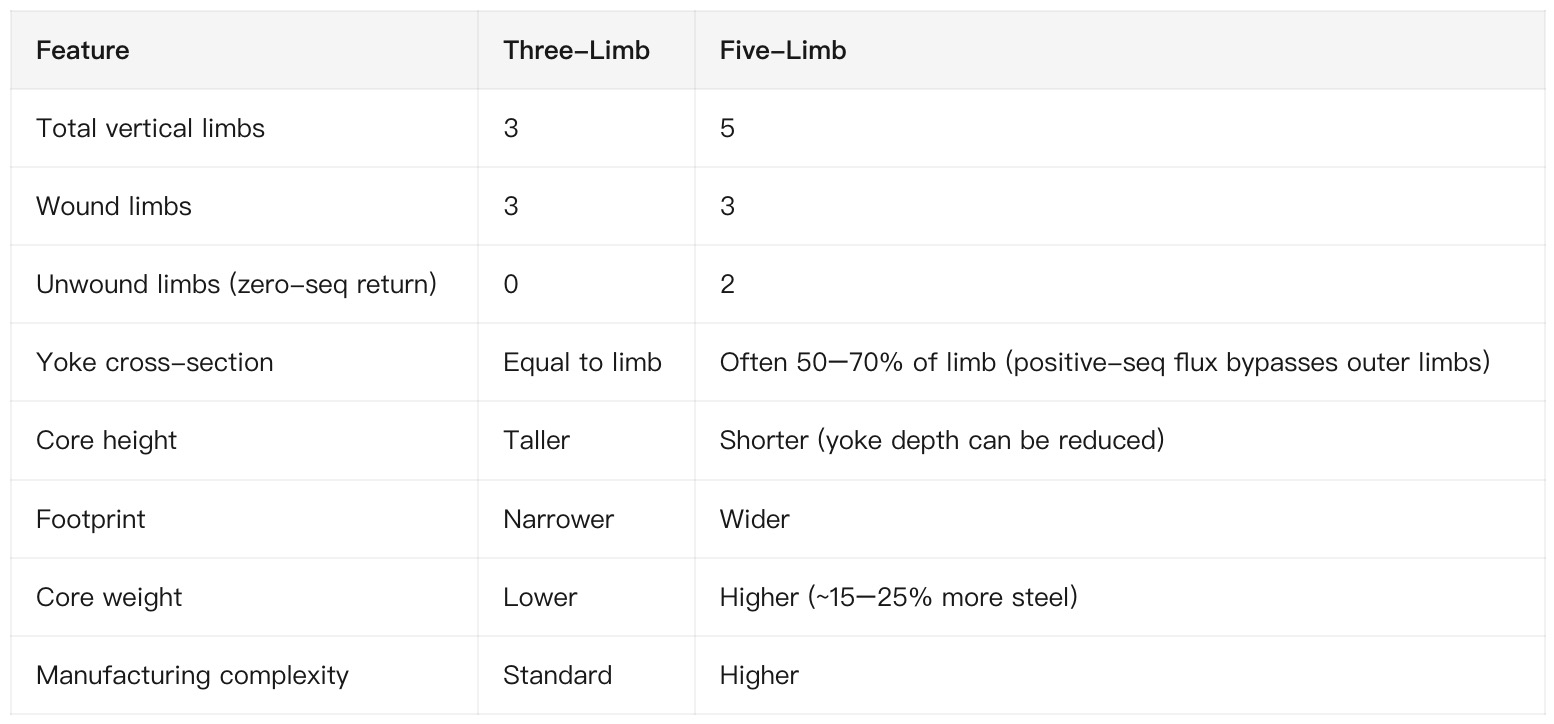 Three-Limb VS Five-Limb
One important note on the yokes: because the outer limbs carry only zero-sequence flux under normal conditions, the yoke cross-section between the outer limbs and the main limbs can be smaller than in a three-limb core. This is one reason the five-limb design can achieve a lower overall height even though it has more limbs — the yokes are shallower.
Three-Limb VS Five-Limb
One important note on the yokes: because the outer limbs carry only zero-sequence flux under normal conditions, the yoke cross-section between the outer limbs and the main limbs can be smaller than in a three-limb core. This is one reason the five-limb design can achieve a lower overall height even though it has more limbs — the yokes are shallower.
- Where Five-Limb Is Required Five-limb cores are specified in three categories of application:
Category 1: Yy vector groups (neutral required on both primary and secondary) When the application requires a wye-wye connected transformer with neutral brought out on both sides (e.g., YNyn0 or YNy11), the zero-sequence current must flow in the neutral. The only practical core option that handles this cleanly is five-limb. Common applications:
1)Grounding/auxiliary transformers at substations 2)Three-phase supply transformers feeding mixed single-phase and three-phase loads 3)Transformers in railway electrification systems
Category 2: Shipping height constraints Large power transformers (100 MVA+) can be too tall to ship by road or rail if built on a three-limb core. The five-limb design reduces overall height by allowing shallower yokes — bringing shipping height within the legal limit for road transport (typically 4.3–4.8 m in most countries). For very large EHV units, the outer limbs may even be shipped separately and assembled on-site.
Category 3: High zero-sequence current environments Transformers in systems with high levels of harmonic zero-sequence current (e.g., data center UPS systems, harmonic-rich industrial loads, traction power) benefit from the five-limb’s superior zero-sequence handling. Third-harmonic currents (which are zero-sequence) can circulate within the delta winding or, in Yy configurations, are better managed with the five-limb’s dedicated return path.
- Manufacturing: What Makes Five-Limb Harder to Build Well Five-limb is not simply “three-limb plus two extra limbs.” The manufacturing complexity increases in ways that affect quality and cost:
More complex stacking geometry With five columns and yokes of non-uniform cross-section, the stacking pattern is more intricate than three-limb. The outer limbs and their yoke connections must be stacked simultaneously with the main limbs, and the step-lap pattern must be maintained at every joint — including the joints at the top and bottom of the outer limbs.
Tighter tolerance requirements Because the zero-sequence return path runs through the outer limbs, any air gap or mismatch at those joints translates directly into higher zero-sequence magnetizing current. The quality of the outer-limb joints matters as much as the main-limb joints — which is not the case in a three-limb design.
Yoke cross-section variation In a three-limb core, all yoke sections are identical. In a five-limb core, the yokes connecting main limbs to outer limbs have a different cross-section from the main yokes, meaning more lamination shape variety and more complex cutting patterns.
Handling and clamping The wider footprint and non-uniform mass distribution of a five-limb core require more careful clamping design. Uneven clamping force on the wider frame leads to vibration and noise — especially at the outer limbs, where the clamping force must be balanced with the main limb clamping.
A well-built five-limb core uses the same core materials (CRGO 0.23/0.27/0.30 mm, step-lap joints, stacking factor ≥0.95) and the same manufacturing precision as a three-limb core. But it requires more tooling complexity and more rigorous process control to achieve the same quality level.
- Cost and Trade-offs: Is Five-Limb Worth It? The honest answer depends on the application:
Five-limb is worth the extra cost when: 1)Yy vector group is a hard requirement 2)Shipping height or width is constrained (transport cost of a disassembled or oversized 3)transformer often exceeds the five-limb material premium) 4)The transformer will operate routinely with significant unbalanced loads 5)Zero-sequence harmonic content is high (third-harmonic management)
Three-limb with delta winding is the better choice when: 1)Dyn, Yd, or Dd vector group is electrically acceptable 2)Shipping dimensions are not a constraint 3)The load is reasonably balanced
The material premium for five-limb is real — typically 15–25% more silicon steel — but it is often smaller than the logistics cost of shipping an oversized three-limb transformer, or the cost of an electrical redesign to accommodate a delta winding
- What to Specify When You Order a Five-Limb Core Transformer
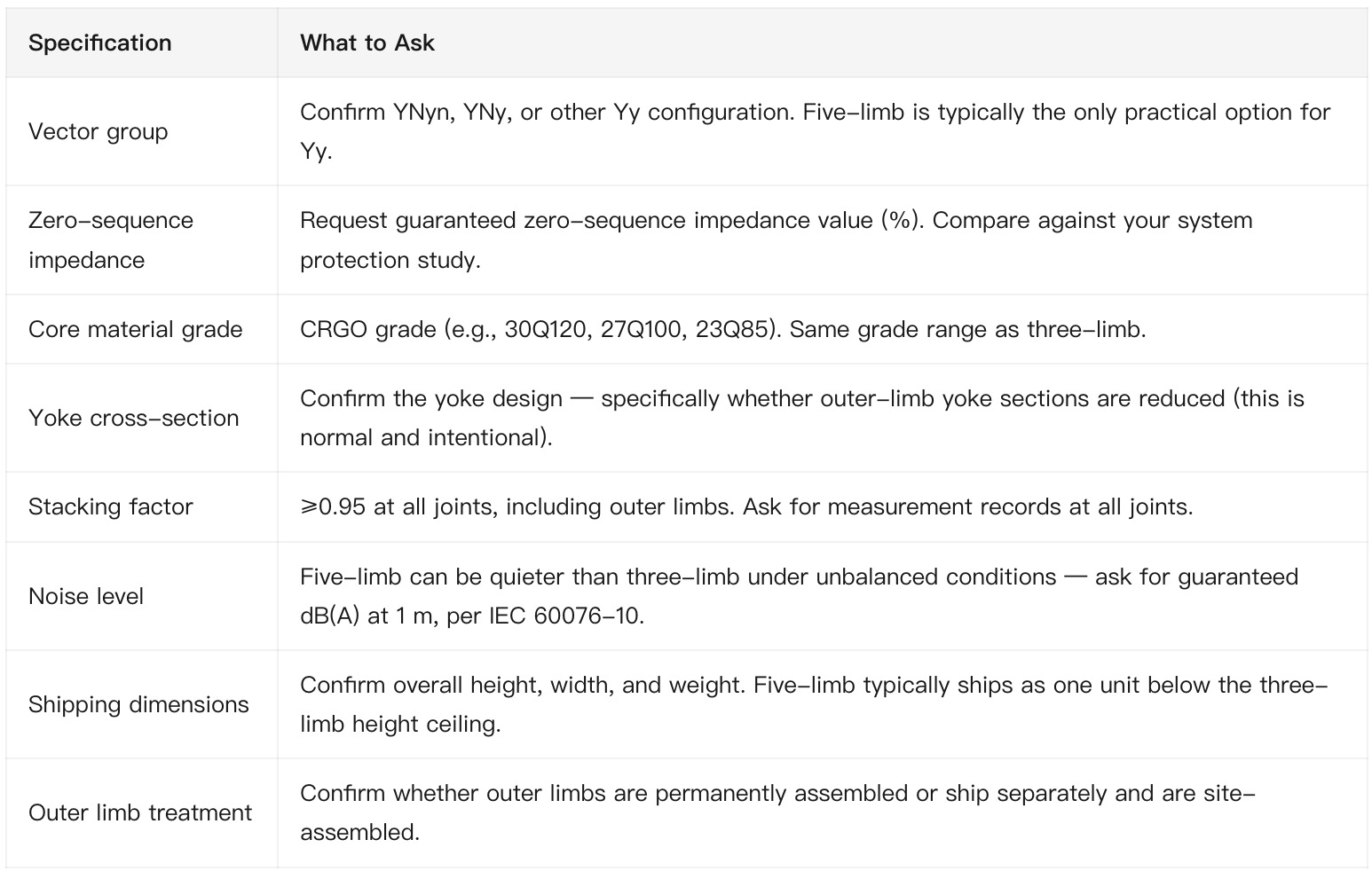 What to Specify When You Order a Five-Limb Core Transformer
- Common Mistakes to Avoid Mistake 1: Specifying Yy on a three-limb core to save cost. This will cause tank heating under ground faults, higher zero-sequence magnetizing current, and possible nuisance tripping of upstream protection. The “saving” becomes a reliability and maintenance problem.
Mistake 2: Not asking for zero-sequence impedance. Unlike short-circuit impedance (which every supplier quotes), zero-sequence impedance is not always included in a standard offer. For Yy transformers, it is critical — it determines how the transformer behaves under ground faults and how much unbalanced current it will draw.
Mistake 3: Assuming five-limb is always taller. In fact, the five-limb design is specifically chosen to be shorter in overall height than a comparable three-limb unit of the same kVA rating. If you are choosing based on shipping height, verify that the five-limb offer is actually providing the reduced height you need — some suppliers may quote five-limb for other reasons (Yy) without optimizing the height reduction.
- Conclusion The five-limb core is not a “better” three-limb — it is a different tool for a different set of problems. Where three limbs cannot provide a zero-sequence return path, cannot accommodate a Yy vector group, or cannot fit within shipping constraints, five limbs steps in with a dedicated solution.
The trade-offs are real: more material, larger footprint, more complex manufacturing. But in the applications where five-limb is the right answer, the alternatives (Yy on three-limb, or shipping a too-tall three-limb transformer) are worse.
For buyers: if your specification calls for a Yy vector group on a large transformer, or if you have a hard shipping height constraint above 100 MVA, ask your supplier specifically about five-limb. Make sure they quote zero-sequence impedance, confirm the stacking factor at all joints (including outer limbs), and verify the shipping dimensions before you sign.
More from the newsroom
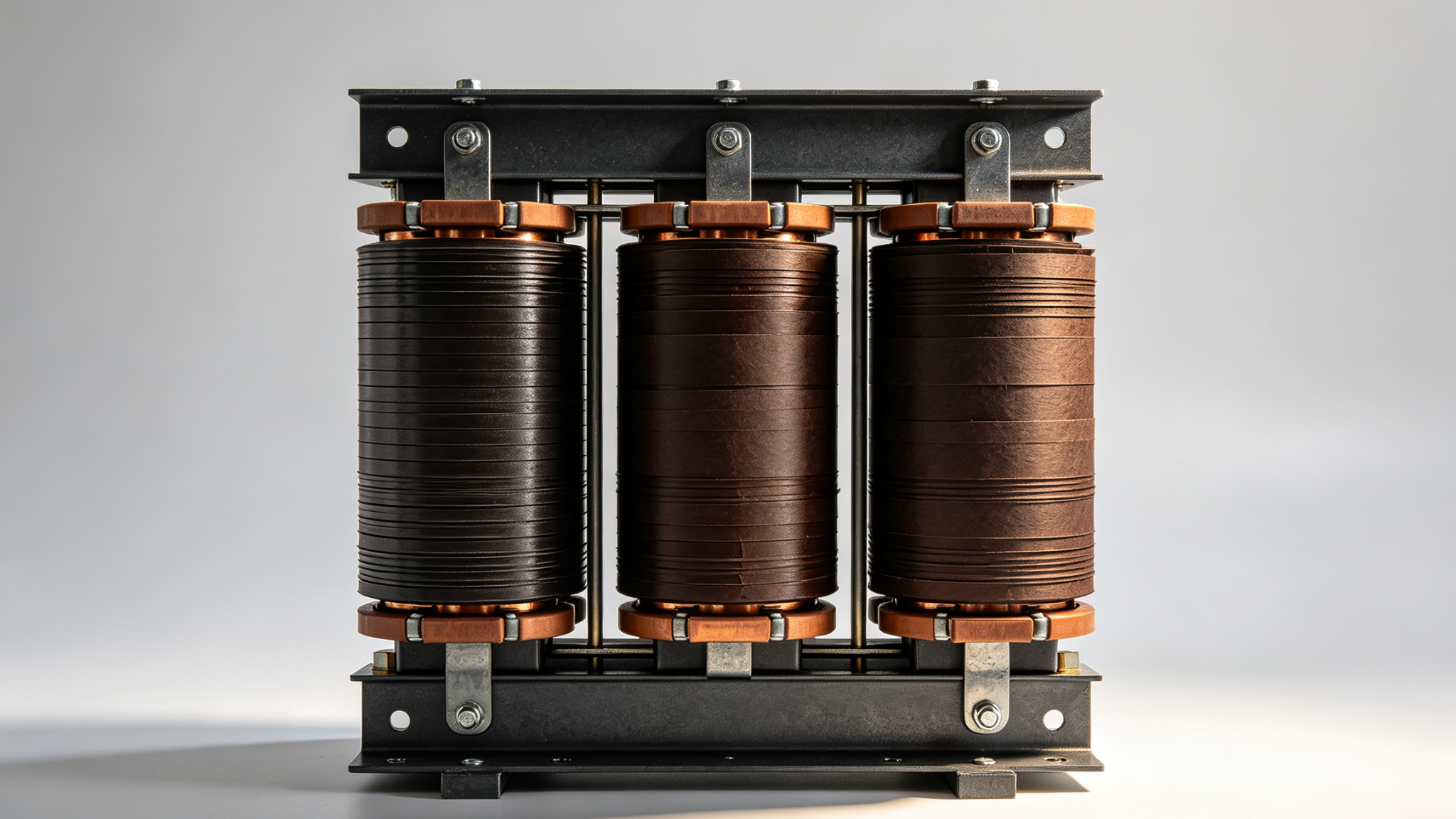
Three-Limb Core: The Workhorse of Three-Phase Transformers — and Why It Matters for Your Order
Sep 18, 2026

Transformer Insulation Components: The “Quiet” Parts That Decide Your Transformer’s Lifetime
Sep 15, 2026

Transformer Bushings: The Most Critical — and Most Overlooked — Component in Your Power System
Sep 11, 2026
Questions about what you just read?
Send your specs or your question — a U.S.-based engineer replies within 24 hours.