Transformer Insulation Components: The “Quiet” Parts That Decide Your Transformer’s Lifetime
In a typical oil-immersed power transformer, over 40% of the internal volume is solid insulation — yet these components are routinely listed as “miscellaneous insulation parts” on quotations and overlooked in procurement. This article examines the oil–paper insulation system in depth: pressboard (cellulose-based structural insulation, 0.8–6.0 mm, three density grades per IEC 60641), electrical densified laminated wood (hardwood veneer composite for load-bearing insulation per IEC 61061), and the engineered geometry of insulating cylinders, angle rings, spacers, and diamond-dotted paper (DDP). The analysis emphasizes that the single most common failure root cause is not material grade but inadequate drying and vacuum oil-impregnation — the processing step where low-cost suppliers most frequently cut corners. A five-question supplier verification checklist is provided for procurement engineers.

Introduction: What Most Quotations Don’t Show When you evaluate a transformer, the specification sheet talks about kVA, voltage ratio, impedance, and no-load/loss figures. The sales conversation centers on the core, the windings, and increasingly the bushings.
But here is what those quotations rarely highlight: in a typical oil-immersed power transformer, more than 40% of the internal volume is solid insulation. The oil–paper insulation system — transformer oil plus cellulose-based components — is the single largest factor determining how long the transformer will actually survive in service.
The components doing that work are what we call insulation components: pressboard barriers, laminated wood clamping structures, insulating cylinders, angle rings, and spacers. Individually, each one may cost a fraction of the transformer’s total price. Together, they are the system that holds electrical clearances, survives short-circuit forces, and prevents the partial discharge that ages a transformer to death.
A $2 million transformer can be taken offline by a $20 spacer that was not dried correctly. This blog explains what these components are, how they work, and the five questions every buyer should ask before signing.
- The Oil–Paper Insulation System: Why Cellulose? In virtually every oil-filled transformer, the insulation system is built on two materials working together: transformer oil and cellulose (insulation paper and pressboard).
This combination is not accidental. It works because of three physical facts:
1)Matching dielectric constants. Transformer oil and cellulose have similar dielectric constants. This means the electric field stress at the oil–paper interface stays low and evenly distributed — there is no sudden stress spike where the materials meet.
2)Oil fills the voids. Dry air has a much lower breakdown strength than either oil or solid insulation. If a gap inside the winding were filled with air, it would become the weakest point. Transformer oil impregnates the cellulose and displaces that air, eliminating the weak link.
3)Oil removes the heat. Beyond insulation, the oil is the coolant that carries heat from the windings and core to the tank walls.
The enemy of this system is moisture. Even trace amounts of water inside the cellulose sharply reduces dielectric strength and accelerates aging. And any residual air gap becomes a site for partial discharge (PD) — invisible, silent, and cumulative. Over years, PD erodes the insulation until breakdown occurs.
This is why the entire insulation system — not just the material grade, but the drying and impregnation process — determines transformer lifetime.
- Pressboard: The Workhorse Structural Insulator What it is: Transformer pressboard is a thick, rigid, cellulose-based material made from high-purity wood pulp. Unlike insulation paper (which is thin, ≤0.5 mm, and used to wrap conductors), pressboard is 0.8–6.0 mm or more thick and serves a dual role: electrical insulation and mechanical structure.
Why it matters: Pressboard is what maintains the electrical clearances between windings and between windings and the core or tank — while also holding the windings in place against short-circuit electromagnetic forces and thermal expansion. Without it, modern high-voltage oil-immersed transformers would not be mechanically reliable.
Density grades (this is where buyers should pay attention):
Grade Density (g/cm³) Typical Use Low-density 0.75–0.90 Angle rings, soft cylinders, formed parts (high oil absorption, easy to shape) Medium-density 0.95–1.15 Insulation cylinders, spacers, oil-duct strips, general parts High-density 1.15–1.30 Clamping plates, end insulation, heavy-load blocks (T1 hard / T4 extra-hard)
Common forms and applications:
1)Insulation cylinders / tubes — separate the winding from the core or from an adjacent winding; also act as the winding former 2)Interwinding barriers — maintain electrical separation between HV and LV windings 3)Spacers and oil ducts — create cooling channels for oil circulation while holding mechanical clearance 4)Angle rings — control the electric field at winding ends (critical at high voltage) End rings and molded parts — axial and radial support for windings
Key specification points:
1)Excellent oil compatibility — works with mineral oil, natural ester, and synthetic ester fluids 2)After proper drying and vacuum impregnation, exhibits low partial discharge and stable long-term dielectric performance 3)Complies with IEC 60641 (pressboard and paper for electrical purposes) and IEC 60076 (power transformers)
Because pressboard is thicker and more robust than paper, it typically outlasts thinner insulation paper components in service — provided moisture is controlled.
- Laminated Wood: The Structural Backbone What it is: Electrical densified laminated wood is made from hardwood veneers (typically birch, beech, or maple), impregnated with insulating resin, and hot-pressed under high temperature and pressure. The densification process compresses the wood fibers to roughly three times the density of natural wood, producing a rigid, oil-compatible board.
Its unique role: Laminated wood is the material you use when you need both mechanical load-bearing and electrical insulation at the same time. Pressboard excels at insulation; laminated wood excels at carrying load.
Inside a transformer, laminated wood components must:
1)Carry the weight of the windings 2)Resist the compression of clamping assemblies 3)Withstand short-circuit electromagnetic forces 4)Damp vibration from magnetic flux cycling 5)Maintain isolation between live parts and the grounded structure Typical components: clamping rings and pressure plates, support beams, core clamping structures, lead supports, HV equipment insulation frames.
Grades and standards:
1)Lamination direction grades per IEC 61061: KP2022 (parallel), KP2024 (cross-laminated, better dimensional stability), KP2026 (tangential, for ring/curved structures) 2)Compliance: IEC 61061 / IEC 60893, and regional standards such as IS 1322
Manufacturing advances worth knowing:
1)7° mitered joint veneers (vs traditional lap joints) eliminate density unevenness and internal voids — improving both mechanical strength and dielectric performance for high-voltage grades 2)X-type one-piece pressed pressure rings: fiber direction arranged radially in an X pattern, integrally formed in one step. Result: uniform radial bending strength, density ≥1.1 g/cm³, radial bending strength >120 MPa, finished diameters up to 2,400 mm.
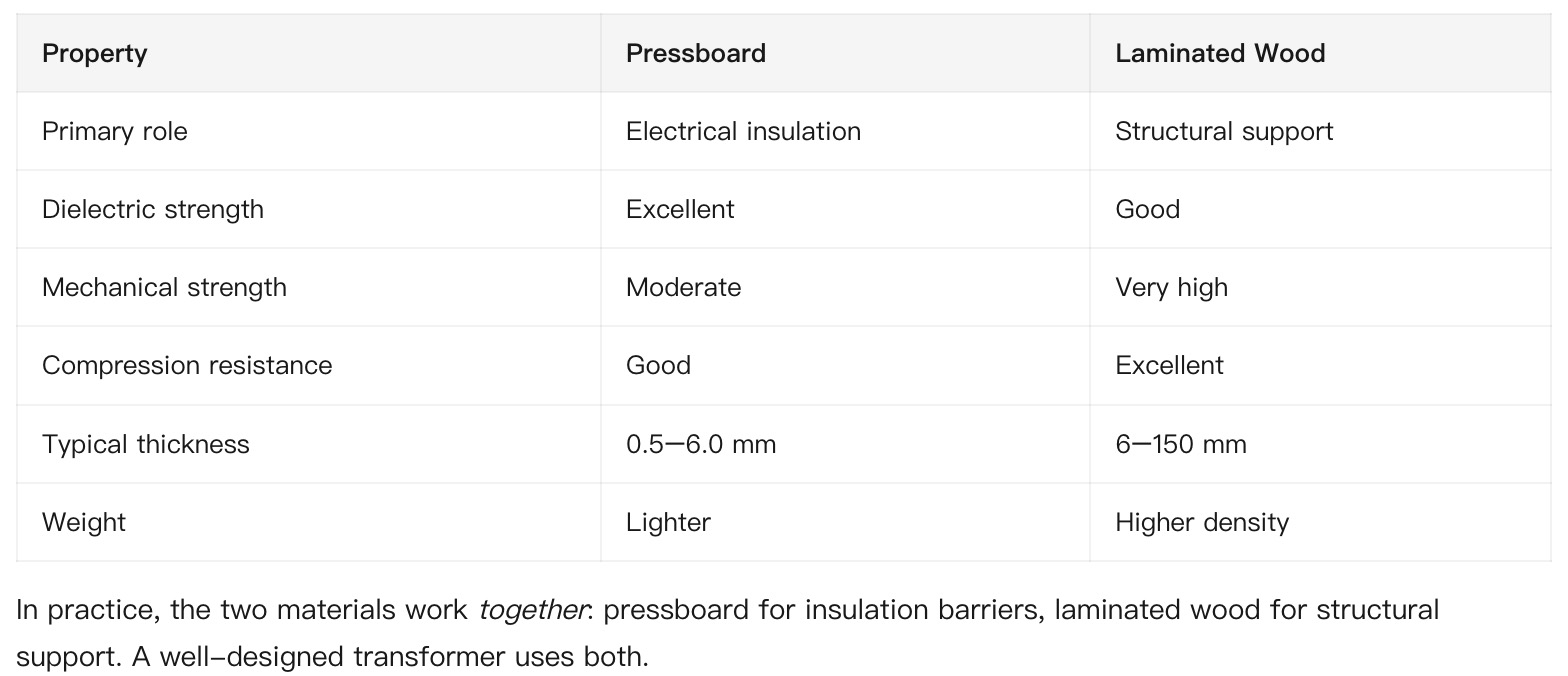 Pressboard vs. laminated wood — quick comparison
- Cylinders, Angle Rings & Spacers: The Geometry That Matters The individual parts may look simple, but their geometry is carefully engineered:
1)Insulating cylinder (paper / phenolic / epoxy-glass tube): serves as the winding former and adds “main insulation” oil gaps between the winding and the core. More oil gaps = stronger insulation. 2)Angle rings: placed at the axial/radial corners of windings to control the electric field concentration at those ends. At high voltage, the angle ring design is a major factor in whether the winding end will survive without PD. 3)Spacers and oil ducts: maintain electrical clearance and create the channels that let oil circulate for cooling. Poorly designed ducts mean hot spots — and hot spots mean accelerated aging. 4)Diamond Dotted Paper (DDP): an innovation where kraft paper is embossed with a diamond-dot pattern, creating microscopic 0.1–0.2 mm oil channels between conductor layers. This improves oil circulation, reduces hot spots, and helps bond layers together. For high-power transformers where thermal management is critical, DDP offers measurable performance over plain kraft paper.
The lesson for buyers: insulation components are not generic “blocks and rings.” Their shape is part of the electrical design.
- The Mistake Buyers Actually Make: Drying & Impregnation Here is the part that separates a reliable insulation system from a liability — and it is the part most easily hidden in a low quote.
A perfectly graded pressboard or laminated wood part is worthless if it has not been properly dried and vacuum-impregnated. Cellulose absorbs moisture from the air. If that moisture is not driven out and replaced with oil under vacuum, the result is:
1)Reduced dielectric strength 2)Partial discharge at operating voltage 3)Accelerated thermal and oxidative aging 4)Premature failure — sometimes years before design life
When you are comparing suppliers, the material certificate is necessary but not sufficient. You should also ask about the drying process, moisture-content specification, and vacuum oil-impregnation procedure. This is exactly where low-cost suppliers cut corners, and exactly where the failure usually starts.
- Five Questions to Ask Your Insulation Component Supplier
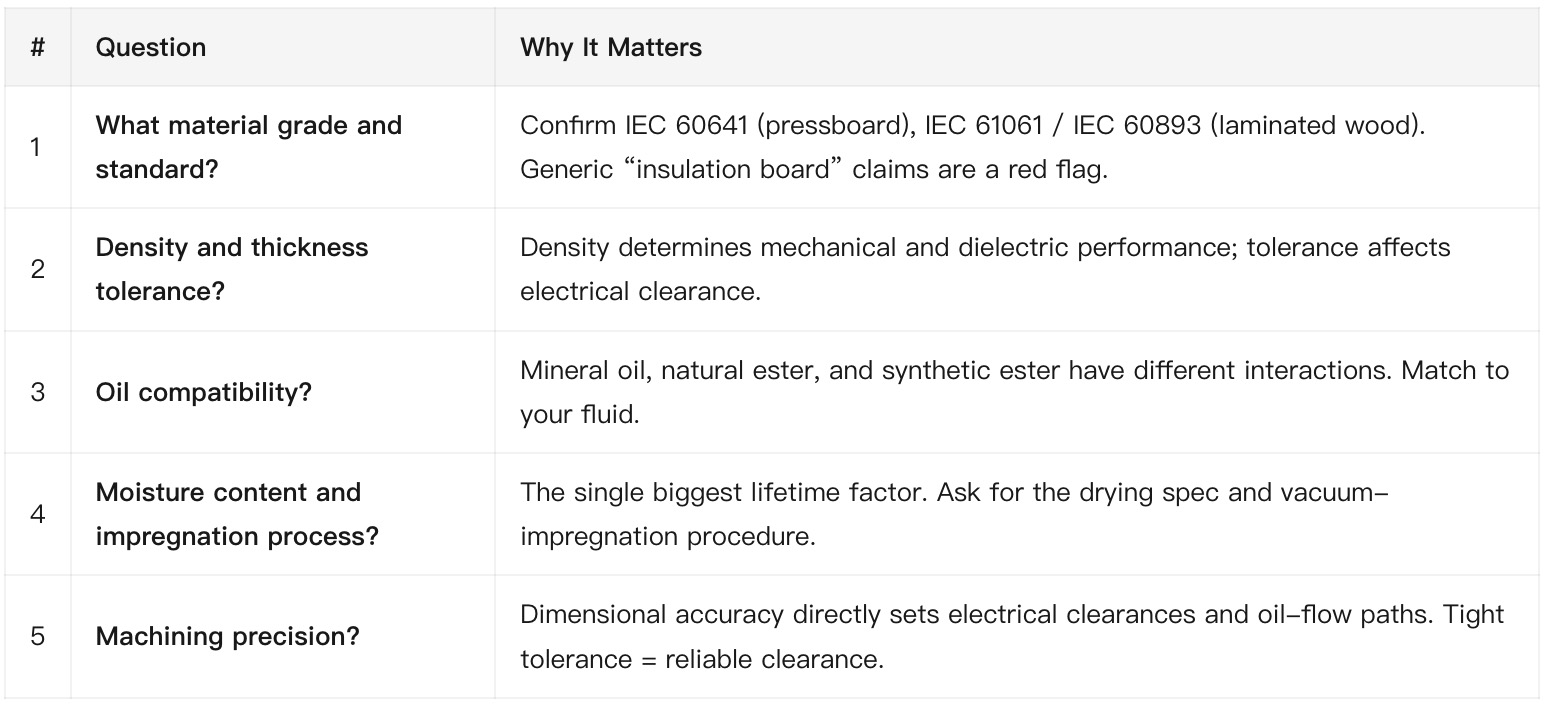 Before you approve a bill of materials or accept a transformer into service, check these:
- Conclusion Transformer insulation components are often treated as commodities — listed as “miscellaneous insulation parts” on a quotation and forgotten. They are anything but.
The oil–paper insulation system, built from pressboard, laminated wood, cylinders, angle rings, and spacers, is the system that decides whether your transformer reaches its 30-year design life or fails in year 7. The material grade matters. The geometry matters. And the drying and impregnation process matters most of all.
For transformer OEMs: your insulation system is your reliability reputation. Specifying the right components — and processing them correctly — is not a cost line to trim. It is the difference between a transformer that earns trust and one that earns a warranty claim.
More from the newsroom

Transformer Bushings: The Most Critical — and Most Overlooked — Component in Your Power System
Sep 11, 2026

Why Transformer Cores Are Laminated: The Hidden Physics Inside Every Dry-Type Transformer
Sep 9, 2026

The Grid Supercycle: What IEA’s 2026 World Energy Investment Report Means for Power and Transformers
Sep 3, 2026
Questions about what you just read?
Send your specs or your question — a U.S.-based engineer replies within 24 hours.