How Geopolitical Tensions Are Reshaping the the Global Power Transformer Supply Chain
Geopolitical shocks — the Russia-Ukraine war, U.S.–China decoupling, and the Red Sea crisis — have fundamentally reshaped the global power transformer supply chain, driving critical raw-material shortages, freight-cost surges, and lead times stretching from weeks to over six months. It urges industry players to build “strategic resilience” through nearshoring, material innovation, and supply-chain diversification, elevating supply-chain security from an operational cost to a core competitive capability.
Introduction
The global power transformer market — valued at approximately $4.5 billion in 2026 — sits at the intersection of energy security, industrial policy, and geopolitical rivalry. Once considered a mature, stable sector, the industry is now being fundamentally rewired by a confluence of trade wars, regional conflicts, and strategic resource competitions. From silicon steel sheet shortages triggered by Russian-Ukraine hostilities to U.S.-China technology decoupling reshaping copper wire supply chains, power transformer manufacturers and buyers alike are navigating an era of unprecedented complexity.
This article explores how current geopolitical tensions are affecting the key components, trade routes, and pricing dynamics of the global power transformer supply chain — and what buyers, investors, and policymakers should watch in the quarters ahead.
- The Critical Raw Materials at Stake Power transformers are fundamentally machines of steel and copper. Understanding the geopolitical exposure of their key inputs is essential.
1.1 Silicon Steel Sheets (Grain-Oriented Steel) Grain-oriented electrical steel (GOES) is the backbone of transformer cores. Over 80% of global GOES production is concentrated in three countries:
China (~45% of global capacity) Japan (~25%, led by JFE Steel and Nippon Steel) South Korea (~10%, primarily POSCO) Russia, once a modest producer, has effectively exited the export market following international sanctions. This concentration means any disruption in East Asia cascades globally. In 2023–2024, Chinese export controls on certain steel products and Japanese production cuts to prioritize domestic infrastructure created noticeable lead time extensions for transformer manufacturers in Europe and North America.
Key Insight: China’s dominance in silicon steel places it in a strategically significant position. Any escalation in cross-strait tensions or further trade decoupling could trigger a structural supply shortage that alternative producers cannot rapidly fill.
1.2 Copper — The Lifeblood of Windings Copper accounts for approximately 25–30% of a transformer’s raw material cost. Chile and Peru together supply over 40% of the world’s mined copper. However, geopolitical factors are reshaping copper trade in ways that go beyond traditional mining economics:
U.S.-China decoupling: Chinese state-backed firms have been aggressively acquiring copper mining stakes in Latin America, creating dual-use supply chains that intertwine with Belt and Road Initiative (BRI) investments. Sanctions on Russian copper: While Russia is not a top-3 copper producer, its copper exports — particularly from the Norilsk region — served European manufacturers. Sanctions and logistics disruptions have forced European buyers to re-source from Chile and Congo, adding 15–20% to logistics costs. Copper price volatility: LME copper prices surged from ~$8,000/ton in 2020 to a peak of $11,000+/ton in 2024, driven partly by speculative flows tied to geopolitical risk premiums. 1.3 Transformer Oil (Mineral & Bio-based) Transformer oil — both traditional mineral oil and newer biodegradable alternatives — relies on specific refining processes. Russia and Belarus were historically significant suppliers of naphthenic crude oil, preferred for transformer oil production. With these sources cut off, European and North American manufacturers have shifted to Nigerian, Angolan, and Saudi Arabian crude, or invested in bio-based alternatives (rapeseed, soybean, and synthetic esters). While supply chains are adapting, costs have risen by an estimated 8–12% compared to pre-2022 baselines.
- Trade Route Disruptions: How Logistics Have Changed 2.1 The Red Sea Crisis (2024–Present) The Houthi attacks on commercial vessels in the Red Sea have forced major shipping lines to reroute around the Cape of Good Hope. This has significant implications for transformer logistics: Europe ↔ Asia routes extended by 10–14 days Freight costs for transformer-sized cargo (typically 20–40 ft containers or flat racks) increased by 30–50% in late 2024 Many European utilities with long-term supply contracts with Asian manufacturers faced clause disputes over force majeure
2.2 U.S.-China Tariffs and Section 301 Duties The Biden-era Section 301 tariffs imposed a 25% duty on Chinese-made power transformers in 2024, a move that has been largely retained under subsequent administrations. This has driven three major strategic shifts: Reshoring: U.S. utilities and industrial buyers are increasingly sourcing from domestic manufacturers (ABB, Eaton, Prolec GE) and Mexico-based plants (Mitsubishi, Hyundai). Friendshoring: Procurement is shifting toward “trusted nation” suppliers in South Korea, Japan, and Canada.
Tariff engineering: Some Asian manufacturers have begun establishing semi-knockdown (SKD) assembly operations in third countries (Vietnam, Morocco, Mexico) to avoid direct tariff exposure — a practice that is legal but creates quality oversight challenges.
- Case Study: How the Russia-Ukraine Conflict Changed European Transformer Markets Europe’s energy infrastructure has undergone the most dramatic transformation of any region since 2022. Consider the following shifts:
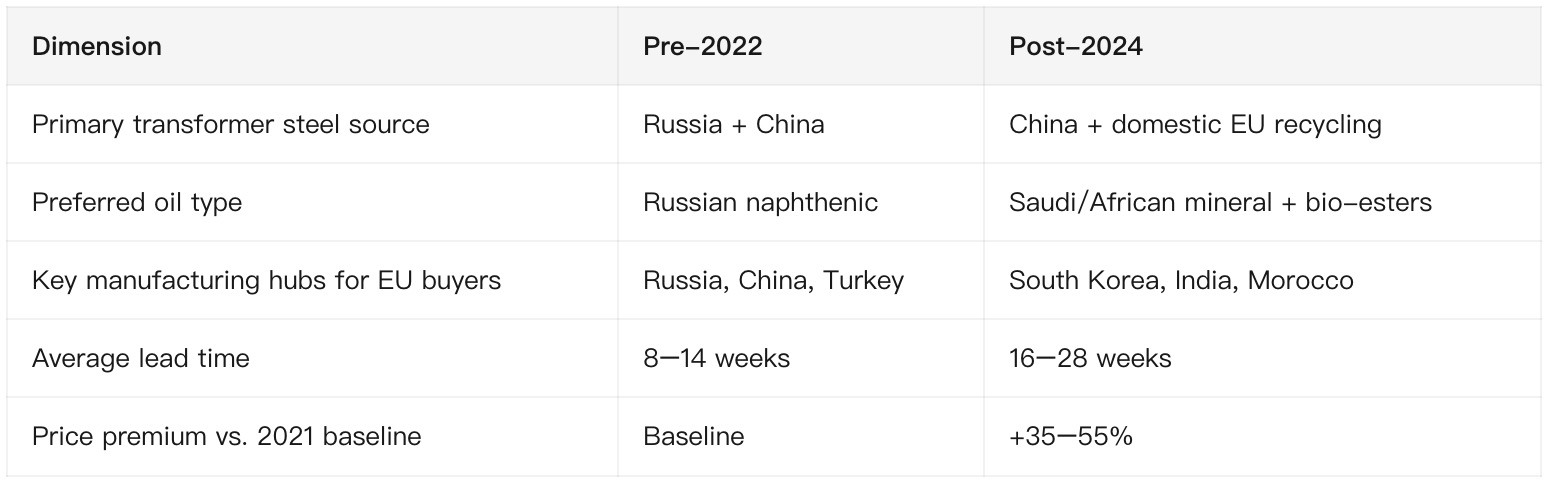 Europe’s energy infrastructure has undergone the most dramatic transformation of any region since 2022. Consider the following shifts
The conflict accelerated Europe’s “Transformer Independence Strategy,” which includes:
€3.2 billion EU Innovation Fund supporting domestic transformer manufacturing Grid hardening programs in Germany, Poland, and the Netherlands driving demand beyond supply capacity Strategic stockpiling by grid operators (TenneT, RTE, National Grid) — a behavior previously unseen in the industry 4. The China Factor: Strategic Competition and Technology Decoupling 4.1 China’s Dual Position as Supplier and Competitor China occupies a unique and contradictory position in the global transformer ecosystem. It is simultaneously:
The largest global producer of distribution transformers A major consumer driving massive grid expansion domestically An increasing competitor at the HVDC (High Voltage Direct Current) transformer level A source of concern for Western national security planners due to grid exposure In 2025, the U.S. Department of Energy issued guidance urging utilities to avoid installing Chinese-manufactured large power transformers (LPTs) in critical grid infrastructure — citing cyber vulnerability concerns. Several NATO member states followed with similar advisories.
4.2 China’s Belt and Road and the “Transformer Corridor” Through the BRI, China has effectively embedded its transformer industry in infrastructure projects across Africa, Central Asia, and Southeast Asia. This creates:
Long-term market lock-in: BRI-linked power projects use Chinese transformer specifications, making future sourcing non-Chinese difficult Technology leadership at scale: Chinese HVDC transformer manufacturers (e.g., XD Group, TBEA) have scaled rapidly on domestic projects, building cost and quality competitiveness now exportable Standard-setting influence: Chinese technical standards (GB standards) are being adopted in BRI countries, potentially displacing IEC standards over time 5. Emerging Supply Chain Solutions and the Road Ahead 5.1 Nearshoring and Friendshoring Boom The most significant structural shift in the transformer supply chain is the rapid acceleration of nearshoring:
United States: The Inflation Reduction Act (IRA) and Infrastructure Investment and Jobs Act (IIJA) have triggered over $2 billion in announced transformer manufacturing investments since 2022, including new facilities by Hyundai Heavy Industries (Alabama), SPX Transformer Solutions (Texas), and WEG (Tennessee). Mexico: Emerging as a major nearshoring hub for U.S.-market transformers, with Brazilian manufacturer WEG and Korean firms Hyundai and Hyosung establishing facilities. Morocco: Positioned as a “gateway to Europe” with preferential trade access and growing industrial capacity, attracting investment from Chinese and Turkish manufacturers. 5.2 Material Innovation as a Geopolitical Hedge Forward-thinking manufacturers are investing in material innovation to reduce supply chain vulnerability:
Amorphous steel cores: Replacing traditional GOES with amorphous metal alloys, which can be produced with less specialized equipment — reducing China dependence Aluminum windings: Copper price spikes have renewed interest in aluminum-wound transformers for certain applications Recycled and circular materials: EU regulations are pushing transformer manufacturers to incorporate higher percentages of recycled copper and steel 5.3 Digital Supply Chain Transparency Blockchain and IoT-based supply chain tracking are being adopted by leading buyers to ensure:
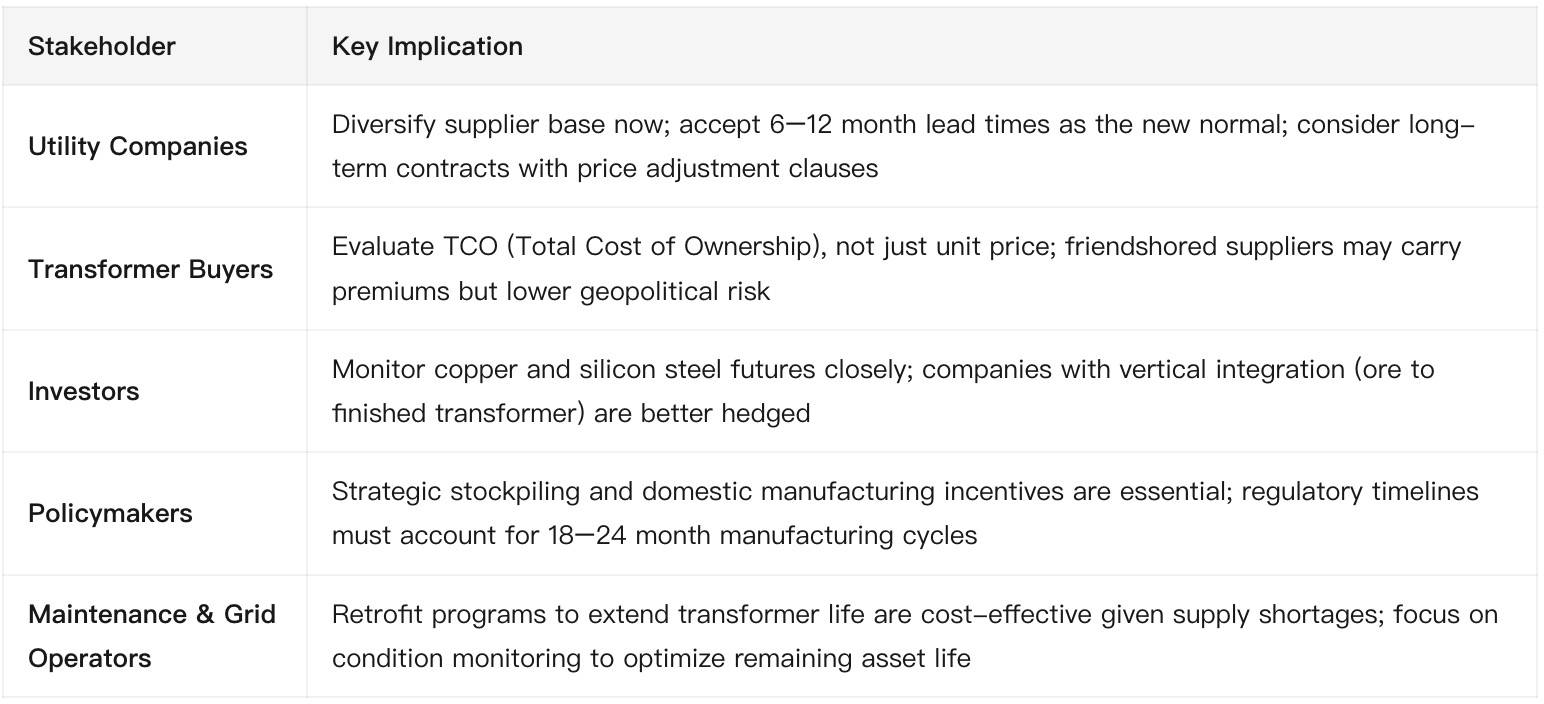
Conflict mineral-free sourcing Carbon footprint verification for Scope 3 compliance Country-of-origin verification to manage tariff exposure 6. Key Takeaways for Industry Stakeholders
 1
Conclusion
The global power transformer supply chain in 2026 is a microcosm of the broader geopolitical realignment underway in the global economy. The comfortable certainties of the pre-2020 era — cheap Chinese steel, stable Russian energy, unrestricted global logistics — have given way to a more fragmented, more expensive, and more strategically charged landscape.
For industry participants, the imperative is clear: supply chain resilience is now a strategic capability, not just an operational function. Companies that invest in diversified sourcing, material innovation, and geopolitical intelligence today will be best positioned to navigate the turbulent decade ahead.
The transformers keeping the lights on are no longer just engineering products — they are geopolitical artifacts.
More from the newsroom
Five-Limb Core: When Three Limbs Are Not Enough — and What Replaces Them
Sep 22, 2026

Transformer Bushings: The Most Critical — and Most Overlooked — Component in Your Power System
Sep 11, 2026

The Grid Supercycle: What IEA’s 2026 World Energy Investment Report Means for Power and Transformers
Sep 3, 2026
Questions about what you just read?
Send your specs or your question — a U.S.-based engineer replies within 24 hours.